
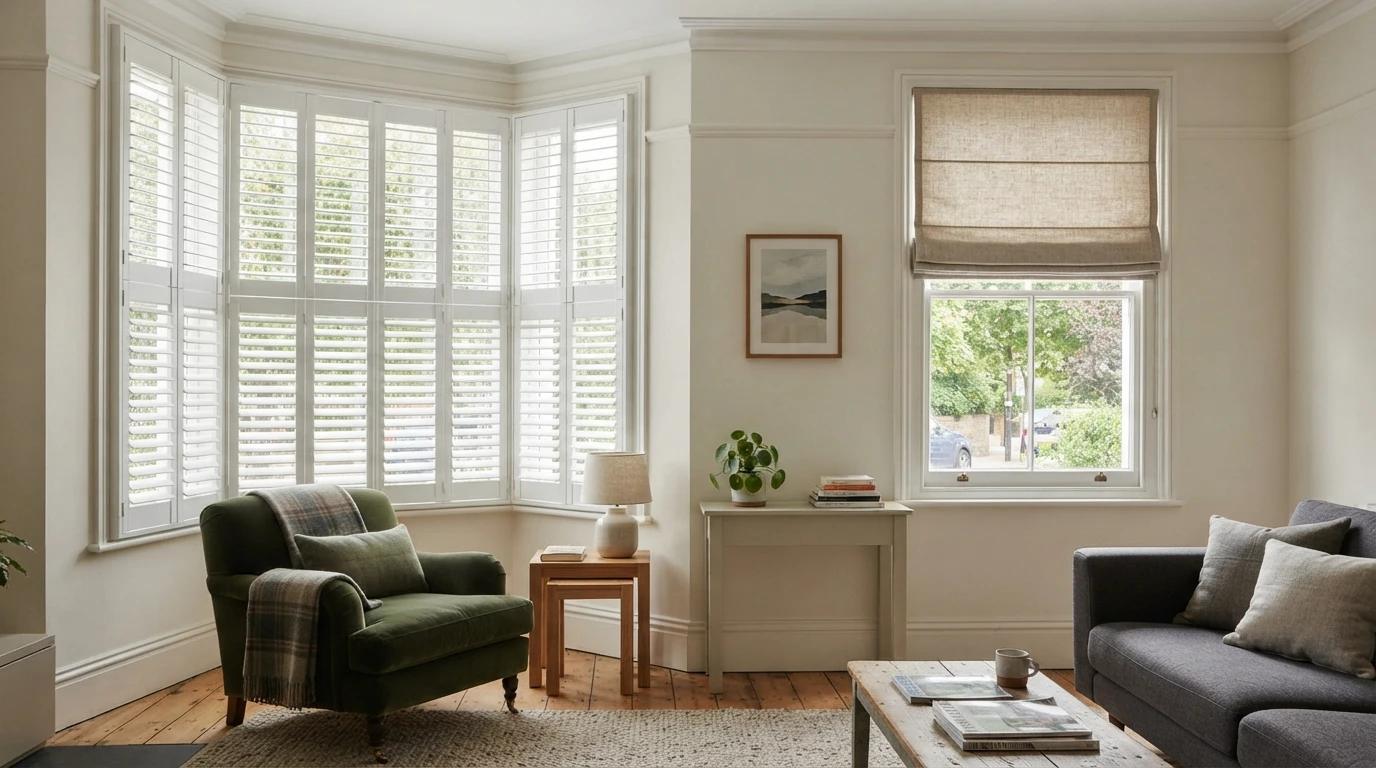
Choosing between shutters and blinds is not simply a question of which one looks better. Both can control light, provide privacy and change the appearance of a room, but they work in quite different ways and come with their own advantages and disadvantages.
Shutters are a more permanent window covering, with solid panels and adjustable louvres fitted to the window. Blinds cover a much wider range of looks, materials and designs, from simple roller blinds to Venetian, Roman, vertical and other styles.
The right choice will depend on your windows, the room, your budget and what matters most to you. In this guide, we compare shutters and blinds across the things you are likely to consider before making a decision, including appearance, materials, finishes, light control, privacy, maintenance, cost and installation.
Rather than assuming one is always better than the other, the aim is to look at where each option has an advantage and where it may not be the best fit.
What to consider with shutters
Shutters have plenty to offer, but there are also some things worth considering before choosing them. Here are some of the main points to keep in mind.
✓ Shutters pros
- A permanent, built in appearance – Shutters become a long term part of the window rather than simply hanging in front of it.
- Good control over light and privacy – Adjustable louvres allow you to change how much light enters and how much of the window can be seen through.
- A range of configurations – Different shutter configurations provide different ways to cover a window and control light and privacy.
- Many material options – Shutters are available in different natural, engineered and synthetic materials, each with their own characteristics.
- Easy to clean – Hard surfaces can be wiped down without removing the window covering.
- Suitable for many different openings – Shutters can be designed around many windows, doors and some unusually shaped openings.
✕ Shutters cons
- Higher initial cost – Made to measure shutters will generally cost more than many standard or made to measure blinds.
- More permanent – Once fitted, they are not as quick or simple to change as a blind.
- Can take longer to manufacture – Made to measure shutters are normally produced to the dimensions of the individual window.
- More involved installation – Accurate measuring and fitting are important, particularly on complicated windows.
- Some materials are unsuitable for moisture – Standard MDF, for example, needs more care around bathrooms and other damp environments.
- Large openings can be more complicated – Wide windows and doors may require more specialist shutter configurations.
What to consider with blinds
Blinds offer plenty of flexibility, but there are also some limitations depending on the type you choose. Here are some of the main points to keep in mind.
✓ Blinds pros
- A wide range of looks – Blinds are available in many colours, patterns, textures and materials, making it easy to create different appearances.
- Many different designs – Different blind designs provide different ways to cover a window, control light and create the look you want.
- Lower starting cost – Many types of blind are available at a considerably lower price than made to measure shutters.
- Easy to change – Blinds can generally be replaced without changing the whole window covering system.
- Good choice for large openings – Certain blind systems are well suited to wide windows, sliding doors and bifold doors.
- Motorisation is widely available – Many types of blind can be operated by remote control or integrated into a home automation system.
✕ Blinds cons
- Shorter lifespan for some products – Fabric, cords, mechanisms and other components can show wear over time.
- More variation in durability – The quality and expected lifespan can differ considerably between different blind types and price points.
- Some fabrics require more care – Fabric blinds can be more difficult to clean than hard shutter surfaces.
- Less of a permanent appearance – Whether this is an advantage or disadvantage depends on how you want the window to look.
- Light can enter around the edges – The amount of light leakage depends on the blind design, installation and position of the fabric or slats.
- Some materials are affected by moisture – Not every blind is suitable for kitchens or bathrooms.
How do shutters and blinds look?
Appearance is one of the biggest differences between the two.
Shutters have a more solid and architectural appearance because the panels and frame sit around the window. They can become a noticeable part of the room rather than simply being a covering placed over the glass.
Blinds tend to have a lighter appearance, although this varies considerably between products. A simple roller blind can be relatively unobtrusive, while a Roman blind can introduce fabric, colour and texture into the room. Venetian blinds can create a more structured appearance, while vertical blinds have a very different look again.
Blinds also offer a wider range of colours, patterns and textures, particularly where fabric is involved.
This means there is no straightforward winner when it comes to appearance. Shutters tend to suit homeowners looking for a more permanent window feature, while blinds provide more ways to change the softness, texture and overall character of the room.
Styles and configurations
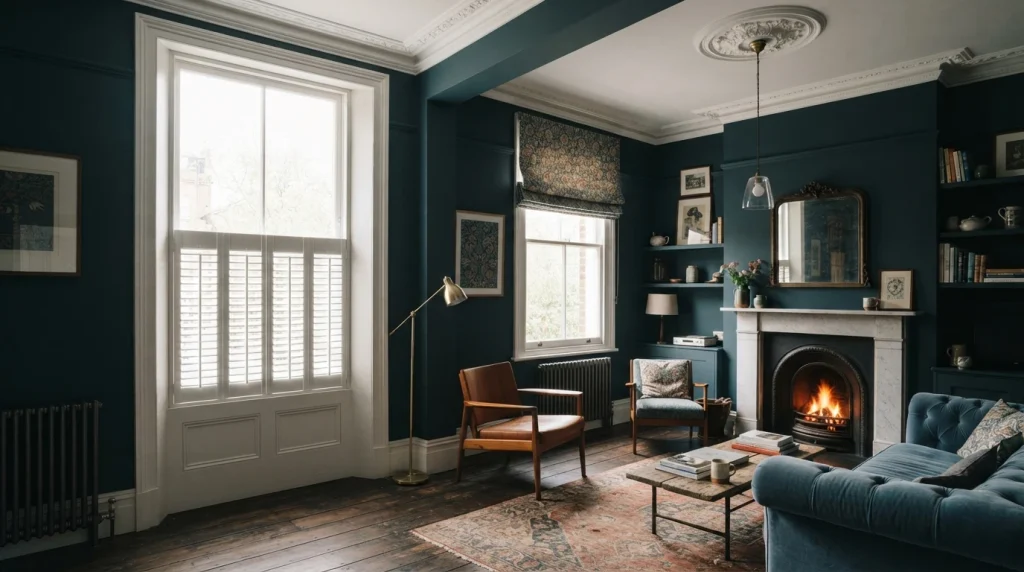
The range of styles available is another important difference.
Shutter configurations
Shutters can be configured in several ways depending on the window and how you want to use it.
- Full height shutters cover the entire window and provide adjustable light and privacy across the opening.
- Tier on tier shutters divide the window into two independently opening sections, allowing the upper and lower panels to be operated separately.
- Café style shutters cover only part of the window, usually the lower section, leaving the upper area open to allow more natural light into the room.
- Solid shutters use solid sections rather than adjustable louvres and provide a different appearance and approach to light control.
Blind designs
Blinds are available in many different designs, each working slightly differently.
- Roller blinds use a single piece of material that rolls around a tube. They can be relatively simple and unobtrusive, with blackout and other fabric options available.
- Venetian blinds use horizontal slats that can be tilted to adjust light and privacy. They are available in materials including aluminium, timber and plastic.
- Roman blinds use fabric that folds upwards when opened. They can introduce more texture and pattern into a room than many other blind types.
- Vertical blinds use vertical slats and are often considered for wider windows and doors.
There are also pleated, cellular, panel and specialist blind systems, as well as motorised versions of several different types.
If variety is your main priority, blinds offer more choice in terms of appearance and construction. If you prefer the particular appearance and construction of plantation shutters, the choice is more about selecting the right shutter configuration.
Materials
The materials used can have a significant effect on appearance, weight, durability, moisture resistance and cost.
Shutters can be made from natural timber, engineered materials and synthetic materials. Hardwood provides the natural grain and variation associated with timber, while MDF offers a more consistent engineered surface. Faux wood is a broad term covering several different constructions, while ABS and PVC are synthetic materials often considered where moisture resistance is important.
Blinds offer an even broader range of materials. Depending on the design, you can find fabric, timber, aluminium, PVC, synthetic and composite options.
The important point is that neither shutters nor blinds are made from one single material. Comparing the material used is therefore more useful than simply comparing the product category.
A hardwood shutter and a PVC shutter may have very different characteristics, just as a fabric roller blind and a timber Venetian blind can behave very differently.
Colours and finishes
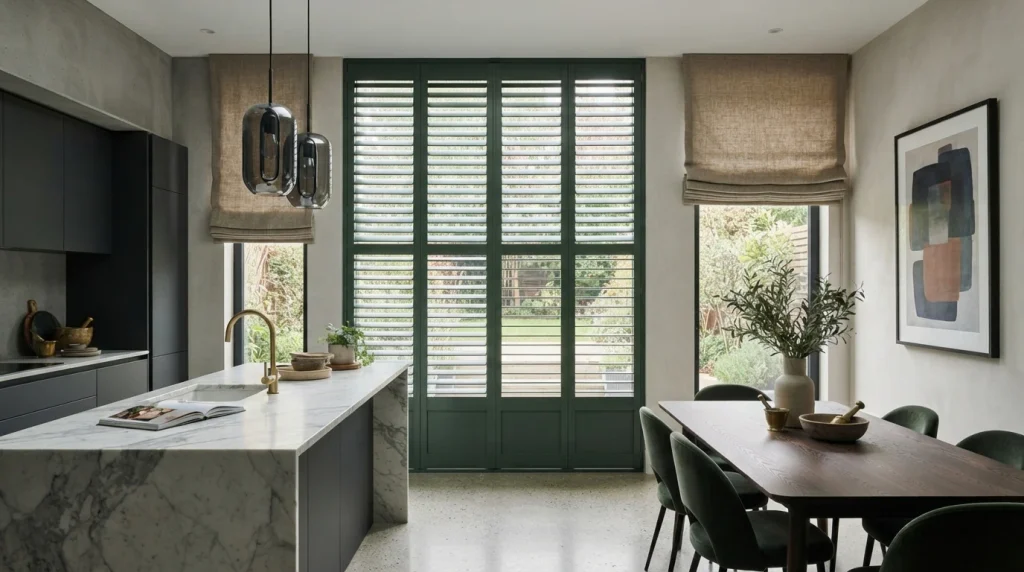
Both shutters and blinds provide plenty of choice when it comes to colour, although they achieve it in different ways.
Shutters can be painted in a wide range of colours or, where natural timber is used, stained to retain the appearance of the wood grain. Some suppliers also offer custom colours or colour matching.
Blinds can offer an even wider range of colours, particularly where fabric is involved. Pattern, texture and different fabric finishes can also become part of the design.
If you want a very specific colour, pattern or fabric texture, blinds may give you more options. If you prefer a clean painted finish or the natural character of timber, shutters provide a different set of choices.
Light control
Both products can control incoming light, but they do it differently.
Shutter louvres can be tilted to different angles, allowing you to adjust the amount of light entering while maintaining some privacy. The panels can also be opened completely when you want an unobstructed view through the window.
Blinds vary considerably. Venetian blinds allow the slats to be tilted, while roller blinds usually provide a choice between the blind being raised, lowered or partially open. Blackout roller and cellular blinds can provide a high level of light reduction when the right fabric and fitting are used.
For precise control, the individual blind design matters just as much as the comparison between blinds and shutters.
Privacy
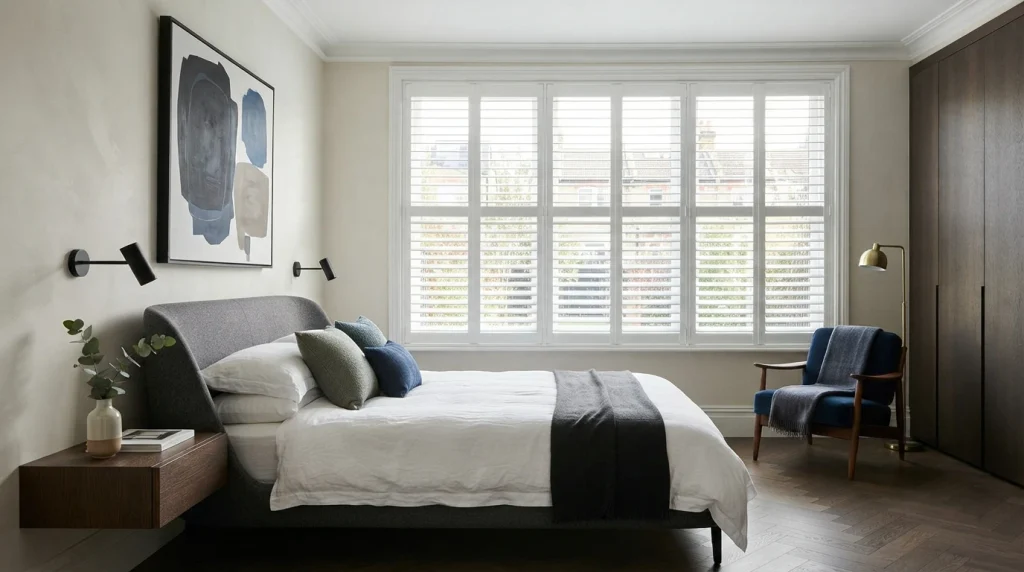
Privacy is another area where both options can work well.
With shutters, the louvres can be angled to restrict views through the window while still allowing some daylight into the room. Tier on tier shutters and café style shutters provide additional ways to cover only the part of the window where privacy is needed.
Blinds can also provide good privacy, particularly Venetian blinds where the slats can be tilted. Roller blinds generally provide privacy by lowering the blind, although some fabrics allow light to pass through even when the blind is closed.
The best option will depend on whether you want privacy across the entire window, only part of it, or the ability to maintain daylight while restricting views.
Insulation and energy efficiency
Window coverings can provide an additional layer between the room and the glass, but their effect on insulation varies considerably.
Shutters create a rigid barrier in front of the window, while blinds use fabric, slats or other materials. The actual thermal effect will depend on the shutter or blind construction, the window glazing, gaps around the covering and how the product is fitted.
Some blinds, particularly cellular or honeycomb designs, are specifically constructed with insulation in mind. A well fitted shutter can also reduce some heat transfer through the window.
It is therefore difficult to say that one category is always more energy efficient. If energy performance is important to you, look at the specification of the particular product rather than relying solely on whether it is a shutter or blind.
Cleaning and maintenance
Hard shutter surfaces can generally be wiped clean, making them relatively straightforward to maintain. This can be useful in kitchens and bathrooms, although the suitability of the material for those rooms still needs to be considered.
Blinds vary much more. Aluminium and PVC slats can usually be wiped down, while fabric blinds may require more careful cleaning. Some fabrics can collect dust or be more difficult to clean thoroughly.
The design and material therefore matter more than simply choosing between shutters and blinds.
Moisture and humidity
Moisture is an important consideration in kitchens, bathrooms and other areas where humidity or occasional splashes are likely.
Some shutter materials, including certain PVC, ABS and faux wood constructions, are designed for areas where moisture is a consideration. Standard MDF and some natural timber products may be less suitable depending on the conditions and construction.
Blinds can also be used in kitchens and bathrooms, but the material needs to be appropriate for the environment. Moisture resistant synthetic blinds can be considered alongside PVC or other suitable materials, while some fabric blinds may be less appropriate close to sources of water or high humidity.
Always check the manufacturer’s specification rather than assuming that a product is suitable simply because it is marketed for a particular room.
What about unusual windows?
This is where the individual window becomes particularly important.
Shutters can be designed around many different window types, including bays, sash windows, casements, tilt and turn windows and some arched or unusually shaped openings. The exact design will depend on the shape, dimensions, opening mechanism and space around the window.
Blinds can also be made for many different window shapes and sizes, and specialist systems are available for some unusual openings.
Neither product should automatically be assumed to work for every window. With unusual shapes, large openings or complicated hardware, it is worth checking what can actually be manufactured and how the finished product will operate.
Shutters vs blinds for doors
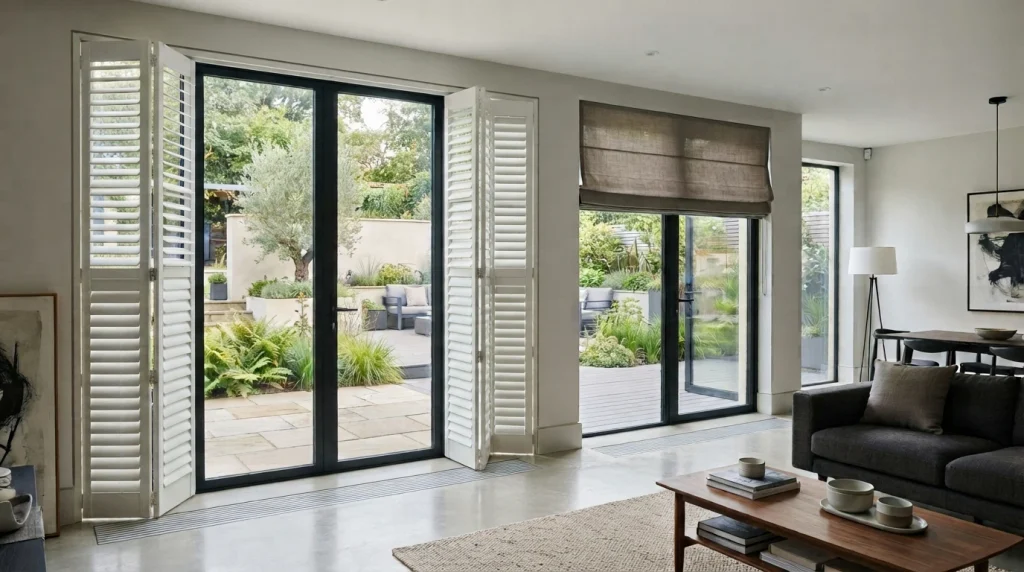
Doors introduce some additional considerations because the window covering needs to work with the movement of the door.
Shutters can be used on French doors, patio doors and some bifold doors, but the configuration and available space need to be considered carefully. The panels need to open without interfering with the door, handles or surrounding furniture.
Blinds can also be used on doors, with roller, vertical, pleated and specialist systems offering different approaches. For very wide openings, some blind systems can be designed to stack or retract away from the opening.
If the door is used frequently, the way the covering opens and where it sits when the door is in use can be just as important as its appearance.
Different rooms, different priorities
The best choice can also depend on how the room is used.
A bedroom may place greater emphasis on privacy and darkness, while a living room may put more importance on appearance, daylight and flexibility. A kitchen or bathroom introduces moisture as an additional consideration, while a large patio or bifold door may require a different approach altogether.
This does not mean that one type of window covering is automatically better for a particular room. The window, the way the room is used and the features that matter most to you are more useful starting points.
Rather than choosing the same covering throughout the house, it can make sense to consider each room and window individually.
How much do shutters and blinds cost?
Cost is one of the clearest differences between the two.
There are blinds available at relatively low prices, while made to measure blinds with premium fabrics, specialist mechanisms or motorisation can become considerably more expensive.
Shutters generally have a higher initial cost because they are made to fit the individual window and involve a more substantial frame and panel construction. The material, shutter configuration, size, finish and whether the shutters are professionally installed can all affect the price.
The comparison becomes more complicated when you consider how long each product is expected to last. A cheaper blind that needs replacing several times is not necessarily the cheapest option over a long period, while paying more for shutters does not automatically make them better value either.
The important thing is to compare the initial cost with the expected lifespan, maintenance and replacement requirements of the particular products you are considering.
DIY or professional installation?
Both shutters and blinds can be bought for DIY installation, although the difficulty can vary considerably.
Made to measure shutters require accurate measurements and need to be fitted correctly so that the panels operate properly. Larger windows, bays and unusual openings can make the process more complicated.
Many blinds are relatively straightforward to install, although this depends on the design, size and fitting method. Motorised blinds can introduce additional considerations around power and control systems.
Professional installation removes much of the practical work, but adds to the overall cost. DIY can reduce the price, but you take responsibility for measuring and fitting the product correctly.
What about longevity?
The expected lifespan can vary considerably within both categories.
A well constructed shutter is generally intended as a long term fixture, and many homeowners choose shutters because they do not expect to replace them frequently.
Blinds have a much wider range of construction and quality. A basic blind may be relatively inexpensive and may eventually be replaced as the fabric or mechanism wears, while a higher quality blind can be designed for longer term use.
This means lifespan should be considered at product level rather than simply assuming that every shutter will outlast every blind.
What about rented properties?
This is one situation where blinds can have a practical advantage.
A blind can generally be removed and replaced more easily, making it a flexible option if you are renting or expect to move in the near future.
Traditional shutters are more permanent and are usually fitted specifically to the window, often involving screws or other fixed fittings. This can make them less suitable for some rented properties, particularly where the landlord does not want permanent alterations.
No Drill Shutters offer another option in some situations. These systems are designed to fit onto compatible windows without drilling into the window frame or surrounding wall, which can make them worth considering where permanent fixing is undesirable. However, compatibility depends on the window construction, glazing bead, handles and the particular system, so they are not suitable for every property.
Whether shutters are appropriate in a rented property will ultimately depend on the type of shutter, the window and the landlord’s permission.
Are shutters worth the extra cost?
This is probably the question behind the entire shutters versus blinds debate.
Shutters can cost considerably more upfront, so the extra expense needs to be justified by what you actually want from the window covering.
If you value a permanent appearance, adjustable privacy, hard wearing construction and a window covering that you expect to keep for many years, the higher initial cost may make sense.
If you are working with a limited budget, want to change the appearance of the room regularly, need a very specific fabric or pattern, or simply want a practical window covering without making a large investment, blinds may make more sense.
There is no universal answer because the value depends on your priorities.
So, shutters or blinds?
There is no single winner.
Shutters offer a more permanent approach, with solid panels, adjustable louvres, a range of materials and several different configurations. They can work particularly well where long term use, privacy, appearance and easy cleaning are important.
Blinds offer greater variety across looks, materials, colours, patterns and price points. They can be easier to change, are often more affordable initially and can be particularly practical for large openings, specialist applications and situations where flexibility matters.
For some homes, shutters will make more sense. For others, blinds will be the more practical choice. And there is no reason you have to choose one throughout the entire house.
You might prefer shutters in some rooms while using blinds on large doors, skylights or windows where a particular blind system is more suitable.
The best choice is ultimately the one that fits the window, room, budget and priorities rather than simply the product that sounds better on paper.
The honest answer
If you are choosing between shutters and blinds, start by deciding what matters most to you.
If it is price and flexibility, blinds are likely to be worth considering first.
If it is a permanent appearance and long term use, shutters may be worth the additional investment.
If it is maximum darkness, look at the actual blackout performance of both rather than assuming either one will automatically win.
If it is moisture resistance, compare the materials and construction of the individual products.
And if you are still unsure, there is nothing wrong with using both. The best window covering can be different from one room to the next.