
ABS Shutters
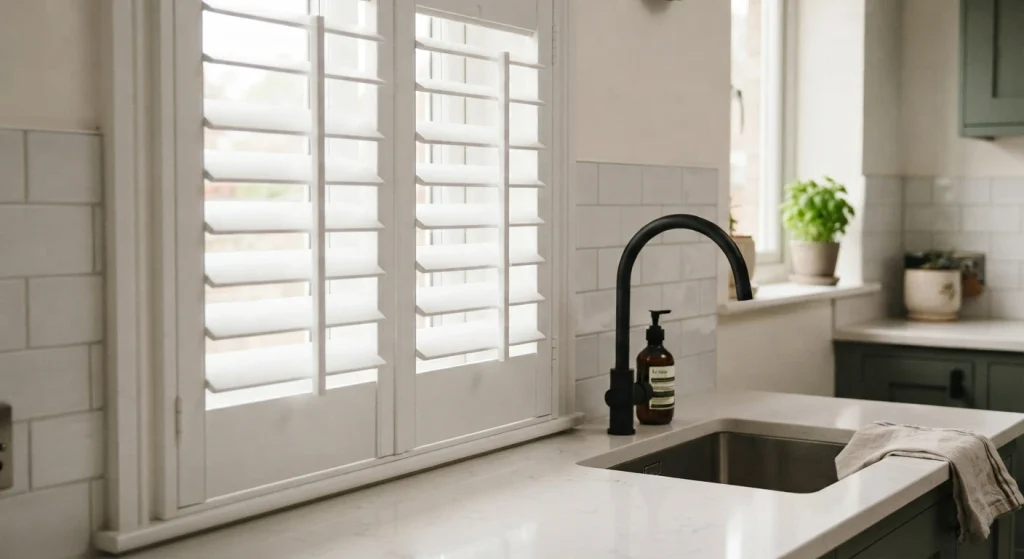
A hard wearing material for moisture prone rooms
ABS, or acrylonitrile butadiene styrene, is a hard thermoplastic used in some shutter constructions. It is lightweight, durable and resistant to moisture, making it particularly useful in rooms where condensation, humidity or occasional exposure to water are considerations. The exact construction can vary between products, so it is worth checking how ABS is used within the shutter.
✓ ABS pros
- Good moisture resistance.
- Suitable for kitchens and bathrooms.
- Hard wearing surface.
- Relatively lightweight.
- Easy to clean.
✕ ABS cons
- Does not have the natural character of real timber.
- Construction varies between products.
- Can have fewer finish and colour options than some timber ranges.
- Not every ABS shutter is suitable for every window shape.
- Can be less appropriate if you specifically want a natural wood appearance.
ABS shutters, fully explained…
ABS stands for acrylonitrile butadiene styrene, a type of thermoplastic used in a wide range of everyday products. In shutters, it is used because the material is hard, relatively lightweight and resistant to moisture. Some products are constructed predominantly from ABS, while others use ABS as an outer layer or coating around a different core material.
What does ABS mean in a shutter?
This distinction is important when comparing products. The term ABS does not necessarily describe the entire shutter, so it is worth checking the manufacturer’s specification to understand what the panels, louvres and frames are actually made from.
Moisture resistance
One of the main characteristics of ABS is its resistance to moisture. This makes ABS based shutters particularly useful in rooms where humidity and condensation are common, such as bathrooms and kitchens. Some products are specifically designed to be water resistant or waterproof, but these terms should be checked against the manufacturer’s specification rather than assumed simply because ABS is used.
A relatively lightweight material
The material is also relatively lightweight compared with some denser shutter materials. This can be useful when designing larger panels, although the overall weight will still depend on the construction, size, thickness and any additional materials used within the shutter.
A consistent painted appearance
ABS provides a smooth, consistent surface and is generally associated with painted finishes. It does not have the natural grain or variation of hardwood, so the finished appearance tends to be more uniform. Some products are designed to closely replicate the appearance of painted timber, while others have a more obviously synthetic construction.
Durability with everyday use
Another consideration is durability. ABS is a hard thermoplastic and can provide good resistance to the knocks and general wear associated with everyday use. However, the performance of the finished shutter will also depend on the construction, hardware, coating and quality of the particular product.
Cleaning and maintenance
Cleaning can also be relatively straightforward, particularly where the shutter has a smooth, moisture-resistant surface. This can be useful in kitchens and bathrooms where the shutters may need regular cleaning. Cleaning methods should still follow the manufacturer’s recommendations.
Colours and window configurations
The available colours, louvre sizes and window configurations can vary between ABS ranges. Some products are designed primarily for standard rectangular windows, while others may be available for a wider range of shapes. It is therefore worth checking the individual range if you have a bay, arched or unusually shaped window.
Overall, ABS is a practical shutter material where moisture resistance, durability and ease of maintenance are important considerations. However, ABS is not a single standardised shutter construction, so the specification of the individual product matters. Checking what the ABS is used for, what sits beneath it and how the finished shutter is designed will give you a much clearer picture of what you are actually comparing.