
Faux Wood Shutters
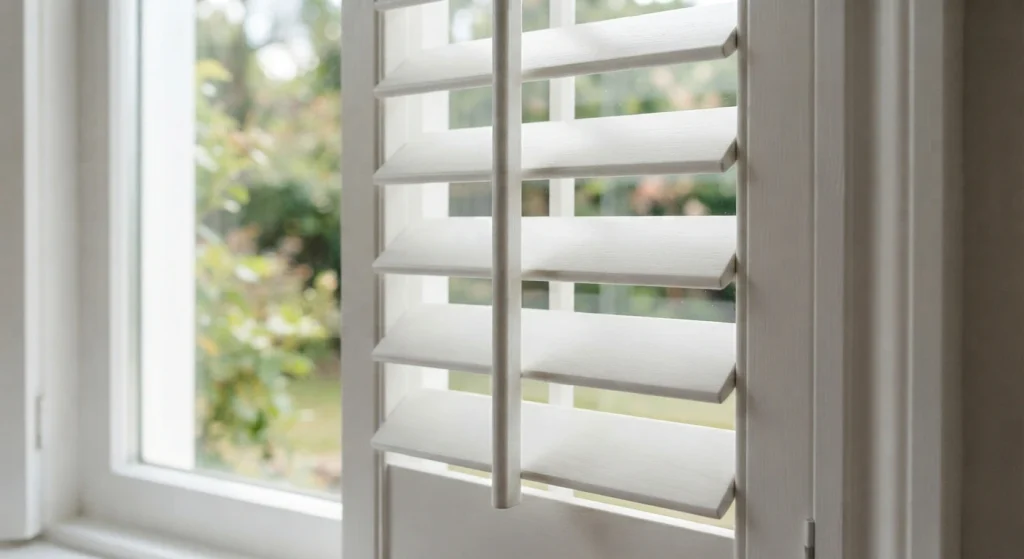
A timber like appearance with a durable construction
Faux wood shutters are designed to replicate the appearance of natural timber using engineered or synthetic materials. Different products can use different constructions, so their weight, durability, moisture resistance and overall appearance can vary depending on how they are made.
✓ Faux wood pros
- Timber like appearance.
- Durable construction on many products.
- Can be a more cost effective alternative to some hardwood shutters.
- Some options offer good moisture resistance.
- Available in different colours and finishes.
✕ Faux wood cons
- Does not have the same natural grain as real timber.
- Construction varies considerably between products.
- Can be heavier than some timber alternatives.
- Appearance can vary between manufacturers.
- Some options may be less suitable for large panels.
Faux wood shutters, fully explained…
Faux wood is a broad term used for shutters that are designed to reproduce the appearance of natural timber using engineered or synthetic materials. There is no single material or construction that defines faux wood, so products can differ considerably depending on how they are made.
Different faux wood constructions
Some shutters use a composite or engineered core with a wood effect surface, while others use synthetic materials throughout. The construction can affect the weight, strength, moisture resistance and overall appearance of the finished shutter, so it is worth checking what is actually being used rather than relying on the term “faux wood” alone.
Appearance similar to natural timber
One of the main reasons for choosing this type of shutter is its timber-like appearance. Modern manufacturing techniques can produce surfaces and finishes that replicate some of the visual characteristics of natural wood, while providing a more consistent appearance across the shutter. However, they will not have the same natural grain and variation as a genuine timber product.
Moisture resistance
The construction can also make some faux wood shutters suitable for situations where moisture resistance is important. This can be useful in areas such as kitchens and bathrooms, although the level of resistance depends on the materials, coatings and construction used. The manufacturer’s specification should always be checked when considering them for moisture prone rooms.
Comparing the cost
Faux wood can provide a more cost effective way of achieving a timber like appearance, although this is not always the case. Some faux wood shutters can carry a higher price because they are manufactured and supplied more quickly than some other shutter products. For some homeowners, the shorter lead time may be worth paying more for, particularly when the shutters are needed within a specific timeframe.
The price will still depend on the construction, size, finish and supplier, so it is worth comparing the complete specification alongside the expected lead time rather than assuming all faux wood shutters are priced in the same way.
Weight and larger panels
Another consideration is weight. Some composite and synthetic constructions can be relatively heavy, particularly on larger panels. This can affect the design and operation of the shutters, so larger windows may require particular attention to the panel size and construction.
Finishes and appearance
The finish can vary between products too. Some are designed to closely replicate painted timber, while others have a more pronounced wood effect surface. Colour choices and available finishes will depend on the particular product and manufacturer.
Manufacturing and lead times
Another potential consideration is lead time. Some faux wood shutter ranges are manufactured closer to the UK market, which can result in shorter production and delivery times than products manufactured overseas. This is not the case for every faux wood shutter, however, the manufacturing location and expected lead time are worth checking when comparing products.
Overall, faux wood describes a range of shutter constructions rather than one specific material. It can offer a combination of timber like appearance, durability and, in some products, moisture resistance, while potentially costing less than certain natural timber alternatives. The specific materials and construction are therefore important when comparing different faux wood shutters.