No drill shutters can be an attractive option if you want to fit window shutters without drilling into your uPVC window frames. However, if your windows have trickle vents, there are a few additional things worth checking before placing an order.
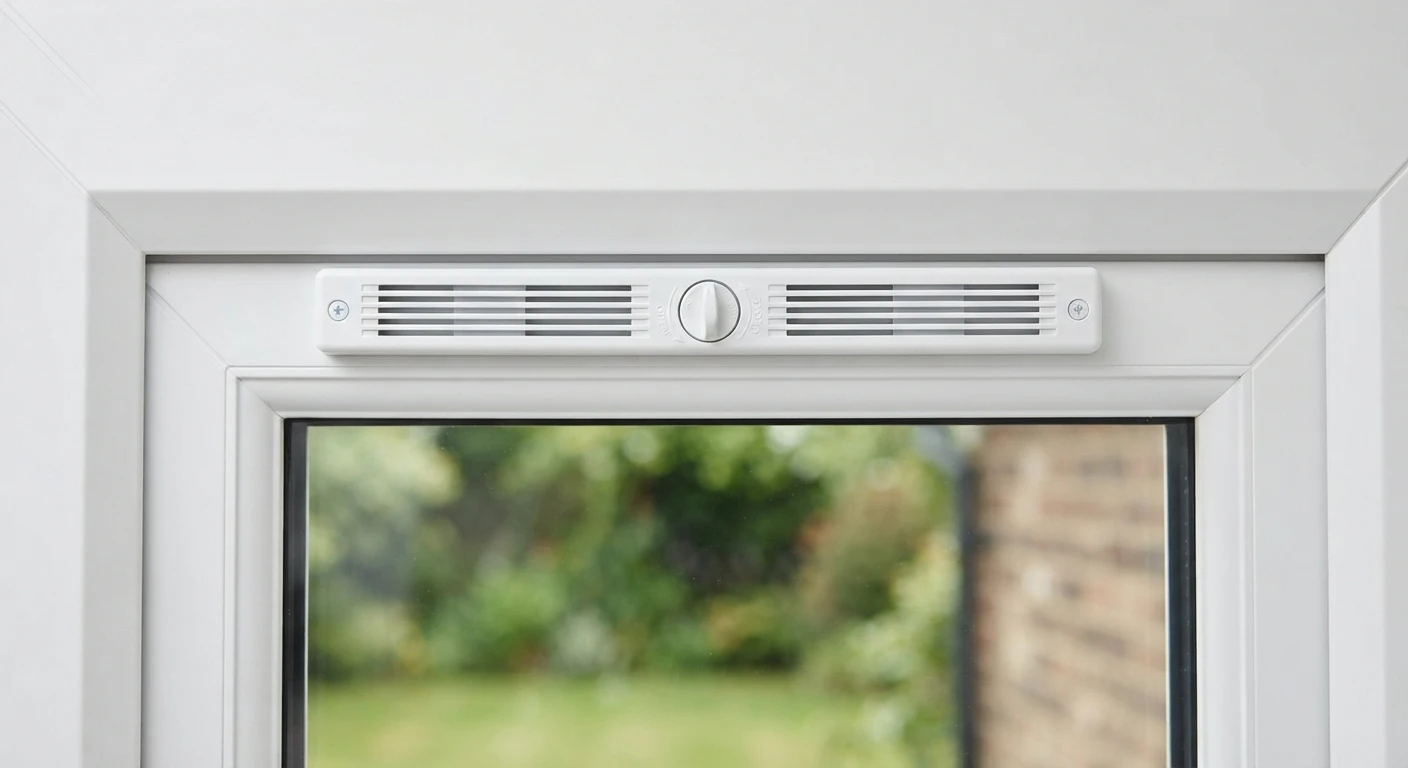
Trickle vents are commonly found along the top of modern windows, providing background ventilation to help maintain good indoor air quality. However, they aren’t always fitted in the same place. Some are incorporated into the opening window panel, while others are fitted into the fixed frame above it. This difference can have a bearing on whether no drill shutters will fit and operate properly.
That doesn’t mean trickle vents and no drill shutters are necessarily incompatible. In some cases, the shutters will fit without any problem, while in others there may be issues with the shutter frame or access to the vent controls.
Why can trickle vents cause a problem?
No drill shutters generally use a frame that clips into the existing window glazing bead, rather than being screwed into the surrounding window or wall. The shutter frame sits around the edge of the glass, so it needs sufficient clearance to fit correctly.
As a general guide, many suppliers specify around 23–25mm of clearance between the edge of the visible glass and any nearby obstruction, including trickle vents, handles and other fittings. This is because the no drill shutter frame typically overlaps the glazing area by a similar amount. If your trickle vent or its operating control sits within this space, it could clash with the shutter frame or prevent the vent from being operated. The exact requirement varies between systems, so always check the manufacturer’s measurements before ordering.
To get a rough idea of compatibility, measure from the edge of the visible glass to the nearest part of the trickle vent or its operating control.
The position of your trickle vent is an important consideration here.
Some vents are fitted directly into the opening window sash (the part of the window that opens). These are often positioned along its top edge, close to the area where the shutter frame needs to sit. Depending on the design, the vent itself or its operating control may interfere with the frame.
Other trickle vents are fitted into the fixed window frame above the opening sash. These may be less likely to cause an issue because they sit outside the immediate area occupied by the shutter frame. However, this will depend on the exact position and dimensions of both the vent and the proposed shutter installation.
It’s therefore worth establishing where your trickle vents are fitted before assuming that no drill shutters will or won’t work with your windows.
Can you fit no drill shutters with trickle vents?
Yes, it may be possible. Having trickle vents doesn’t automatically mean that no drill shutters are unsuitable.
If the vent is positioned clear of the shutter frame, there may be enough room for the shutters to fit without affecting the ventilation system. This can be the case with vents fitted to the fixed frame, although their position still needs checking.
Vents fitted to the opening sash can sometimes present more of a challenge, particularly if they sit close to the glazing bead. However, even these may be compatible with certain shutter systems, depending on their design and the available clearance.
The important thing is to consider the particular window and shutter system rather than relying on a general rule. Different manufacturers have different frame designs and fitting requirements, so the necessary clearances can vary.
The problem with trickle vent controls
Even when the shutter frame doesn’t physically cover the trickle vent, there may still be a problem with the way you operate it.
Some trickle vents have small sliding or hinged controls that need to be moved to open and close the ventilation slot. These can sometimes project downwards or outwards from the window, potentially catching against the top of the shutter frame.
For example, the shutters might fit neatly around the window, but the small operating tab could hit the frame when you try to move it. This could leave you unable to adjust the vent in the normal way.
This is an important distinction. The question isn’t simply whether the shutters will fit, but whether you’ll still be able to use the window and its ventilation features as intended.
What if the shutters fit but restrict access to the vent?
There are a few possibilities, depending on the window and shutter design.
Accepting limited access to the vent
If the trickle vent remains unobstructed but its control is difficult to reach, you may decide that this is an acceptable compromise. However, background ventilators are intended to provide ongoing ventilation, so you should consider your home’s ventilation requirements before accepting a loss of access to the controls.
Temporarily removing the shutter panel
Another possibility is to remove the shutter panel whenever you want to adjust the trickle vent. This will depend on the particular shutter system and whether its panels can be safely removed and refitted.
While this is unlikely to be the most convenient arrangement for everyday use, it may be an acceptable compromise for someone who rarely needs to change the vent position.
Modifying the shutter or vent control
It might be technically possible to create a small cut out in the shutter frame or modify the operating tab to provide additional clearance. However, this isn’t something to assume will be possible or advisable.
Modifying either component could affect its appearance, operation or warranty. Any proposed alteration should be discussed with the relevant shutter supplier and window manufacturer before proceeding.
What if the trickle vent physically clashes with the shutter frame?
In some cases, the position of the trickle vent may prevent the shutter frame from fitting correctly in the first place.
Most suppliers only offer cut outs for specific obstructions, such as window handles, rather than trickle vents. While a modification might be possible in some circumstances, it’s not something you should assume a supplier will be able to provide. Any proposed alteration would need to be assessed carefully to ensure it doesn’t compromise the shutter frame or interfere with the operation of the vent.
If the frame cannot be fitted securely or the vent would become obstructed, the particular no drill system may simply not be suitable for that window.
It may be worth considering a different shutter installation method instead, such as a conventionally fitted shutter frame, which can offer more flexibility over positioning.
What should you check before ordering?
If your windows have trickle vents, it’s worth taking a little extra time to check their position and design before ordering no drill shutters.
Pay particular attention to:
- Where the vent is fitted: Is it incorporated into the opening window sash or the fixed frame above it?
- The position of the vent: How close is it to the visible glass and the area where the shutter frame needs to sit?
- The operating control: Does it slide, lift, pull down or hinge outwards? Will it have enough room to move once the shutters are fitted?
- The shutter frame: Does the particular system have enough clearance to accommodate the vent and its controls?
- Panel access: If the vent becomes difficult to reach, can the shutter panel be removed easily and safely?
- The manufacturer’s requirements: Does the supplier confirm that the window is compatible with its no drill shutter system?
Photographs of the window, including a close up of the trickle vent and its operating controls, can be particularly helpful when asking a supplier to assess suitability.
So, will no drill shutters work with trickle vents?
Not necessarily in every situation, but trickle vents don’t automatically rule them out. Some installations will present no particular problems, while others may restrict access to the vent controls or prevent the shutter frame from fitting properly.
The first thing to establish is whether the vent is fitted to the opening sash or the fixed frame. From there, the actual dimensions, available clearance and design of the operating controls will help determine whether the proposed shutters are suitable.
It’s much better to identify any potential problems before ordering than to discover afterwards that you can’t operate your trickle vents or that the shutter frame won’t fit.
With a little checking beforehand and advice from the shutter supplier, you should be able to establish whether no drill shutters are a practical solution for your particular windows.