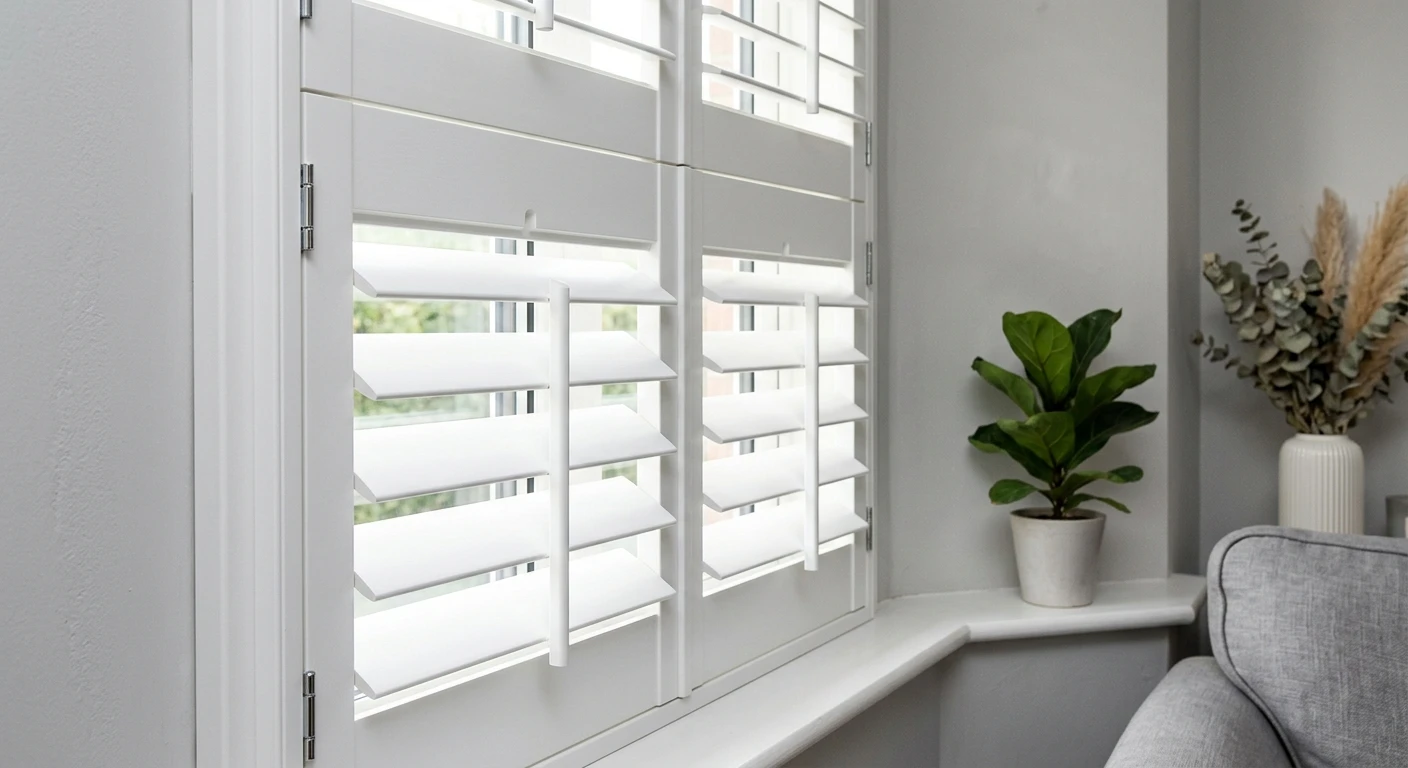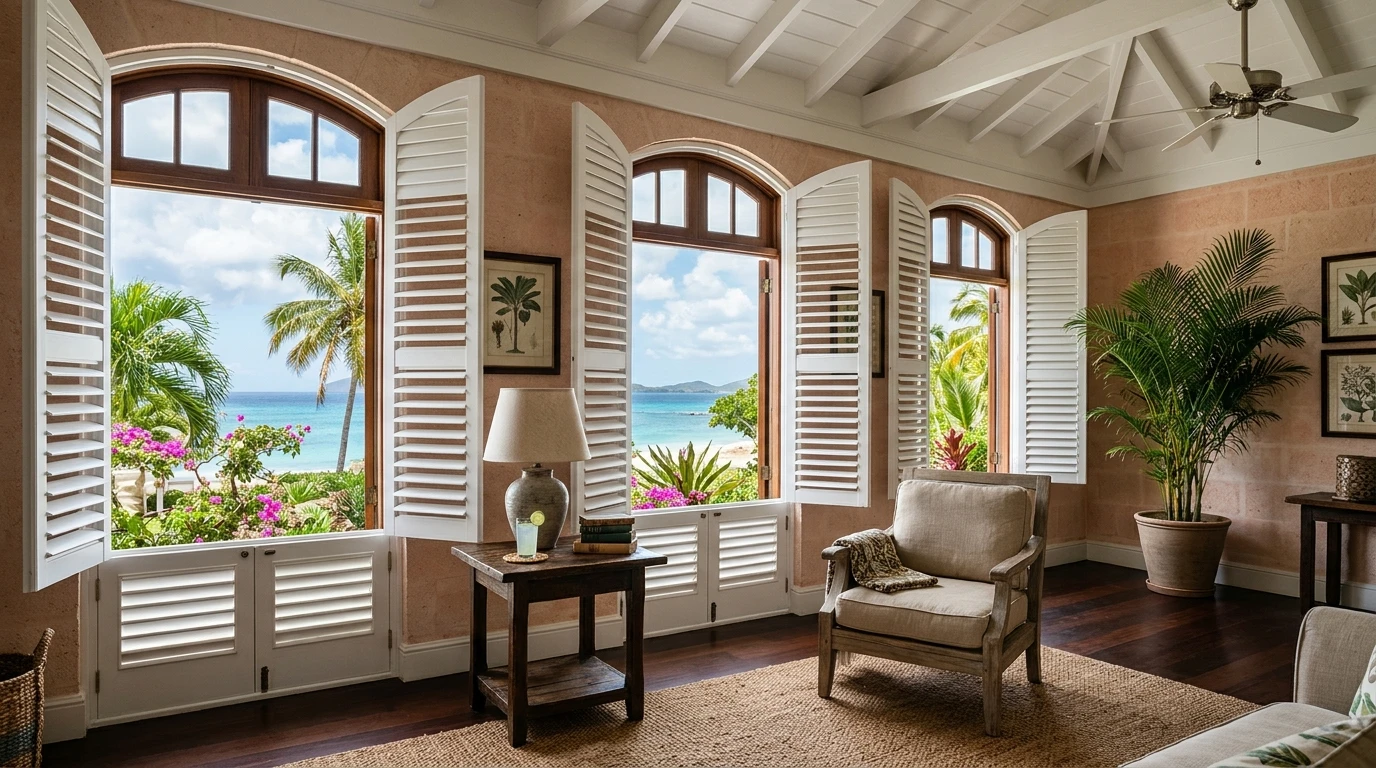
If you’ve been researching window shutters, you’ll probably have come across the term plantation shutters. It’s used everywhere in the UK, from manufacturers and installers to home improvement websites and interior design articles. In fact, it’s become so familiar that many people simply use plantation shutters and window shutters to mean exactly the same thing.
But the term has a more specific history than its modern use might suggest. Plantation shutters traditionally had certain characteristics, particularly their wider louvres and timber construction. Over time, however, shutter designs have evolved, new materials have been introduced and the terminology has become much less precise.
So, what exactly is a plantation shutter? Is there still a difference between plantation shutters and other types of window shutters, or has the name simply become a general term for them all?
Where did plantation shutters originate?
Shutters have been used around the world for centuries, originally serving practical purposes such as providing protection from the weather, controlling light and ventilation, and offering privacy and security. Their designs developed over time, with different materials and styles emerging to suit local buildings, climates and ways of life.
The term plantation shutters is particularly associated with the large houses and plantations of the southern United States and the Caribbean. These properties often featured substantial timber shutters with wide horizontal louvres, which could be adjusted to manage strong sunlight while still allowing air to circulate.
The wider louvres became a defining feature of the style. They were also commonly painted white, giving the shutters the distinctive appearance that many people still associate with plantation shutters today.
Unlike some earlier shutter designs, which used solid panels or narrower louvres, these larger louvred shutters offered a practical way to control sunlight, ventilation and privacy in warmer climates.
European shutters developed their own styles
While the wide louvred plantation style was becoming established in the Americas, Europe already had a long and varied history of window shutters. In fact, many European shutter traditions pre date the plantation style.
Different countries developed designs suited to their architecture and climate. In parts of the Mediterranean, louvred shutters were widely used to provide shade and ventilation, often with narrower slats than those associated with plantation shutters. In Britain, traditional internal shutters were frequently made from timber panels, designed to fold back into the window recess or close across the window for privacy, security and insulation.
These weren’t necessarily plantation shutters in the traditional sense. They were simply different types of window shutters, developed to meet the needs of the buildings and people using them.
There was no single design that defined all European shutters. Solid panels, framed and panelled construction, narrower louvres and different folding arrangements all formed part of the wider shutter tradition.
What traditionally made a plantation shutter different?
Although there isn’t a precise historical specification that every plantation shutter had to follow, a few characteristics are strongly associated with the traditional style.
Wider louvres
Perhaps the most recognisable feature was the use of larger horizontal louvres. Compared with many traditional European louvred designs, plantation shutters generally had wider slats, creating a more open, substantial appearance.
Timber construction
Traditional plantation shutters were made from wood, rather than the engineered and synthetic materials commonly available today. Timber provided the strength and construction needed for substantial shutter panels, while also allowing them to be painted or finished to suit the property.
Large louvred panels
The overall appearance was generally one of generous, louvred panels covering the window. The wider slats gave the shutters a distinctive look, quite different from smaller louvred or solid panel designs.
Simple, often painted finishes
White is particularly associated with the traditional plantation shutter look. Although other finishes existed, painted timber shutters became a familiar feature of the large homes associated with the style.
Taken together, these characteristics help explain what people traditionally meant when they referred to plantation shutters. It wasn’t simply another name for any shutter fitted inside a window.
How modern shutters have changed
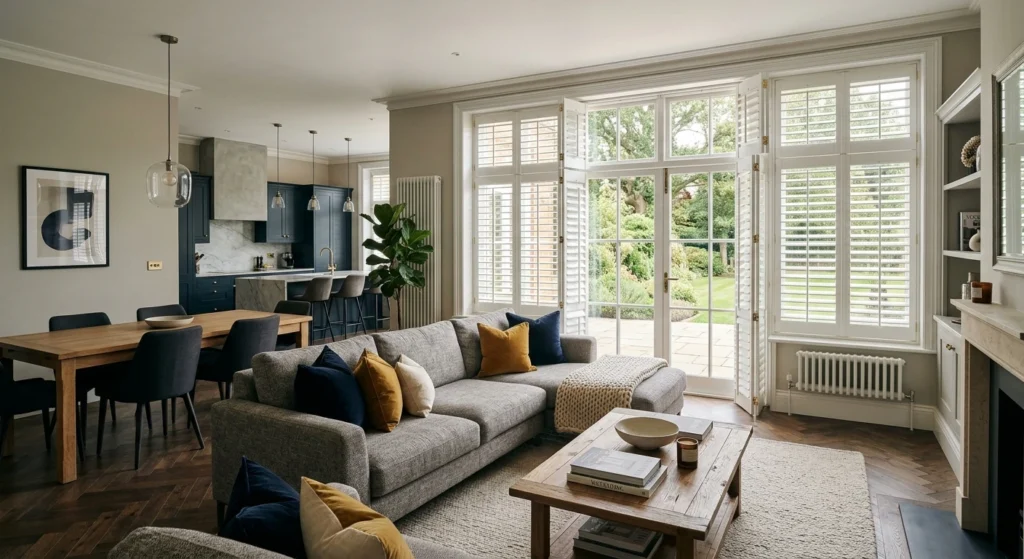
Today’s shutters have moved a long way from those traditional timber designs. Modern manufacturing methods, changing tastes and advances in materials have created a much wider choice of products, styles and configurations.
Natural hardwood remains a popular option, but shutters are now also made using MDF, engineered materials, composites and various plastics, including PVC. These materials offer different characteristics in terms of weight, durability, moisture resistance, finish and cost.
The choice of louvre sizes has expanded too. Modern ranges commonly offer several options, from smaller louvres of around 47 mm or 64 mm through to wider sizes such as 76 mm, 89 mm and 114 mm. The exact selection varies between manufacturers.
This means you can now find a shutter described as a plantation shutter even when it has relatively narrow louvres, is made from a composite or PVC based material, or has a design that looks quite different from the traditional timber examples.
The range of styles has also grown. Full height, tier-on-tier and café style shutters are all commonly sold under the plantation shutter name, alongside solid panel designs and various combinations.
Have different shutter styles come together?
In many ways, yes. Modern interior shutters draw on a much wider range of influences than the traditional plantation style alone.
The broad louvres associated with plantation shutters remain popular, but modern designs also take inspiration from European panel shutters, traditional timber joinery and different ways of covering and dividing a window.
Manufacturers have brought these ideas together with modern materials and fitting systems to create shutters that suit a much wider range of homes and window types. You can now choose from different panel arrangements, louvre sizes, materials, colours and finishes, rather than being restricted to one particular style.
The result is that modern shutters don’t necessarily fit neatly into the historical categories. A contemporary louvred shutter might borrow its proportions from the plantation style, use a modern composite material and have a panel configuration influenced by traditional European shutters.
That’s part of what makes the modern market so varied.
What does plantation shutters mean in the UK today?
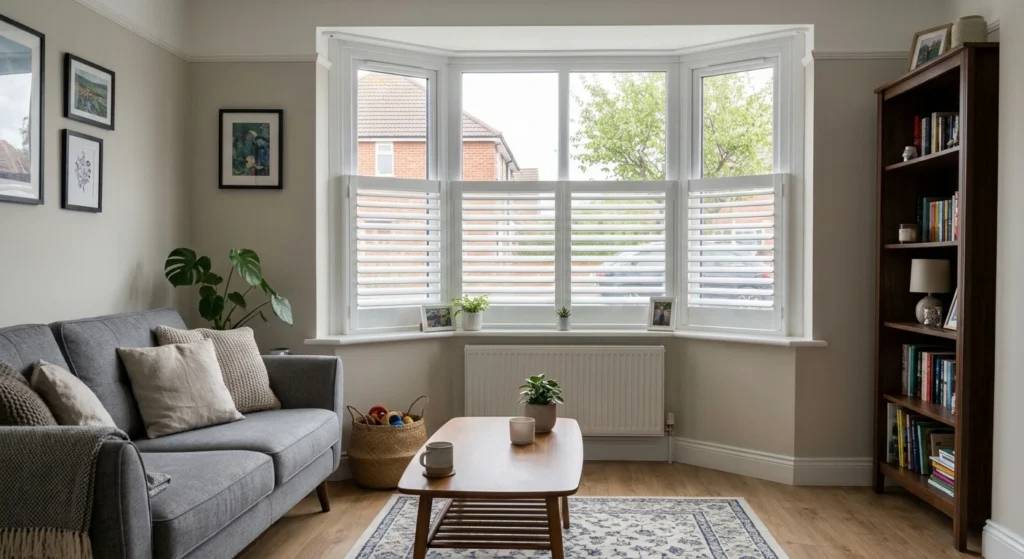
This is where the terminology becomes much looser.
In the UK, plantation shutters has become an established umbrella term for interior louvred window shutters. It’s widely used by suppliers, installers and homeowners, and is often interchangeable with the terms window shutters or simply shutters.
When someone says they’re looking for plantation shutters, they’re not usually making a specific reference to the historical style, the width of the louvres or the material used. They’re generally looking for interior shutters that cover their windows, with adjustable louvres being the familiar design they’re picturing.
The industry has largely adopted the term in this broader sense, and there’s nothing wrong with that. It’s the terminology people recognise and use when researching shutters today.
You might find a supplier describing a hardwood shutter with 89 mm louvres as a plantation shutter, but the same term could also be used for an MDF shutter with smaller louvres or a faux wood product. The label alone doesn’t tell you everything about the construction or appearance.
In other words, the modern meaning is much broader than the original one.
Is there such a thing as a true plantation shutter today?
If you’re looking for a shutter that stays closer to the traditional plantation style, there are still plenty of options.
You’d generally be looking for a natural timber shutter with wider louvres and substantial louvred panels. A simple painted finish, particularly white, can also help recreate the familiar traditional appearance.
However, there is no official modern definition that sets a minimum louvre size or requires a particular timber species. A wider louvre doesn’t automatically make a shutter a traditional plantation shutter, just as a smaller louvre doesn’t mean a modern product cannot be sold under that name.
It’s more useful to think of traditional plantation shutters as a particular style within the much broader world of window shutters.
Looking beyond the name
So, are plantation shutters and window shutters the same thing? In everyday UK usage, very often they are. Historically, however, plantation shutters referred to a more specific style, associated particularly with wider louvres and timber construction.
The distinction is worth understanding, especially when comparing different products. A supplier’s use of the term plantation shutters doesn’t necessarily tell you whether you’re looking at a specific material, or whether the design closely resembles the traditional style.
Rather than focusing too much on the label, look at the actual specification. Consider the material, louvre size, panel configuration, finish and construction, as these are the details that determine what you’re buying.
The name may have changed and the designs have certainly evolved, but the basic appeal remains much the same. Modern shutters bring together ideas from different shutter traditions, adapted for the way we live today. Whether you call them plantation shutters, window shutters or simply shutters, there’s now a much wider choice available than the original style ever offered.