
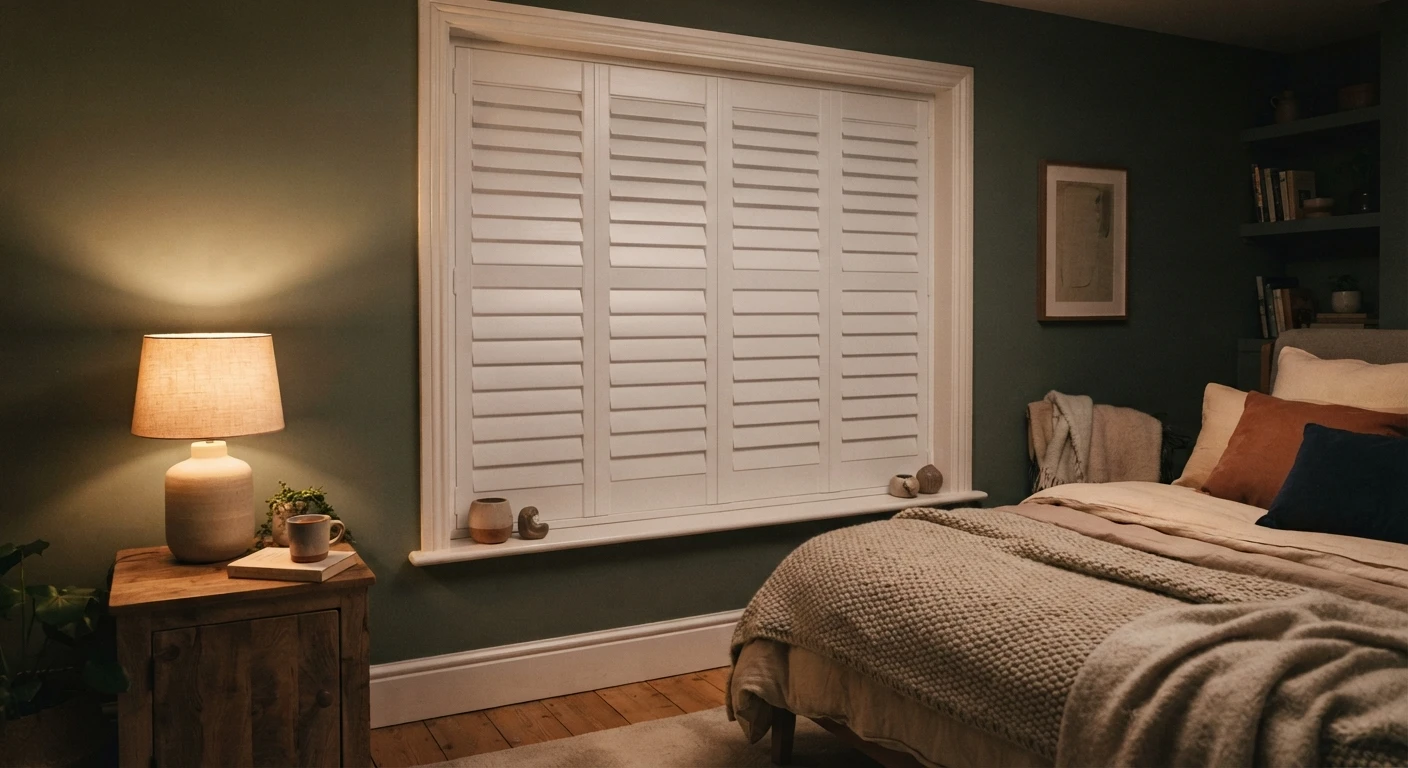
Plantation shutters can make a room noticeably darker, but they do not usually provide complete blackout, despite what some marketing claims may suggest. Their adjustable louvres give you control over daylight and privacy, allowing you to reduce the amount of light entering a room without necessarily blocking it out altogether.
Whether that is enough depends on the room, the amount of light outside and how dark you want it to be. For many people, the balance of light control, privacy and appearance is exactly what makes shutters appealing. If you need a room to be as dark as possible, however, there are a few extra things to consider.
Why don’t shutters provide complete blackout?
With standard louvred shutters, small amounts of light can enter through the gaps between the louvres, even when they are closed. Light can also find its way around the edges of the panels and frame, or through joins where panels meet.
These gaps are part of how shutters are constructed and operated. The louvres need enough clearance to move, while the panels and frame need to fit together in a way that allows the shutters to open and close.
The quality of the fit can also affect the result. A carefully measured and professionally fitted installation may help reduce unwanted gaps around the frame and panels compared with an inaccurate DIY installation. However, even well fitted standard louvred shutters are not designed to guarantee complete blackout, as some light can still pass between the louvres.
The style makes a difference too. Full height shutters can cover the window from top to bottom, while café style shutters deliberately leave the upper part uncovered. Solid panel shutters do not have gaps between louvres, so they may reduce light entering through the panels, but light can still pass around the edges and frame.
The result can be a room that is considerably darker, but still has narrow lines or patches of light. How noticeable these are will depend on the shutter design, the fit, the position of the window and the brightness outside.
Are shutters dark enough for a bedroom?
For many bedrooms, shutters provide a useful balance between daylight control and privacy. You can angle the louvres to reduce direct sunlight, close them for greater privacy and open them when you want more natural light.
However, if you are particularly sensitive to early morning sunlight, work night shifts or need a very dark room to sleep comfortably, the small amounts of light that remain may matter more.
It is worth thinking about how you use the room rather than simply whether shutters make it darker. If you want a softer, darker atmosphere while retaining some daylight control, standard shutters may be sufficient. If you need near total darkness, you may want to consider an additional blackout covering.
Shutters vs blinds and curtains
Each option handles light differently, and none guarantees complete darkness in every installation.
Shutters offer adjustable light control and a permanent, built in appearance. You can change the angle of the louvres throughout the day, but small amounts of light may remain between them and around the frame.
Blackout blinds use opaque fabric or another light blocking material to prevent light passing through the covering itself. The design and fit are important: light can still enter around the sides, top or bottom. A well designed and installed blind that accounts for these gaps can reduce unwanted light.
Blackout curtains use an opaque lining to block light through the fabric. Their effectiveness also depends on how they are fitted. Gaps at the sides, above the curtain or where the curtains meet in the middle can allow light into the room. Wider curtains and a track or pole that extends beyond the window can help reduce these gaps.
If maximum darkness is the priority, a properly fitted blackout blind or lined curtain may be more suitable than standard louvred shutters alone. If you also want the appearance and everyday flexibility of shutters, there is another option.
Can you combine shutters with blackout blinds?
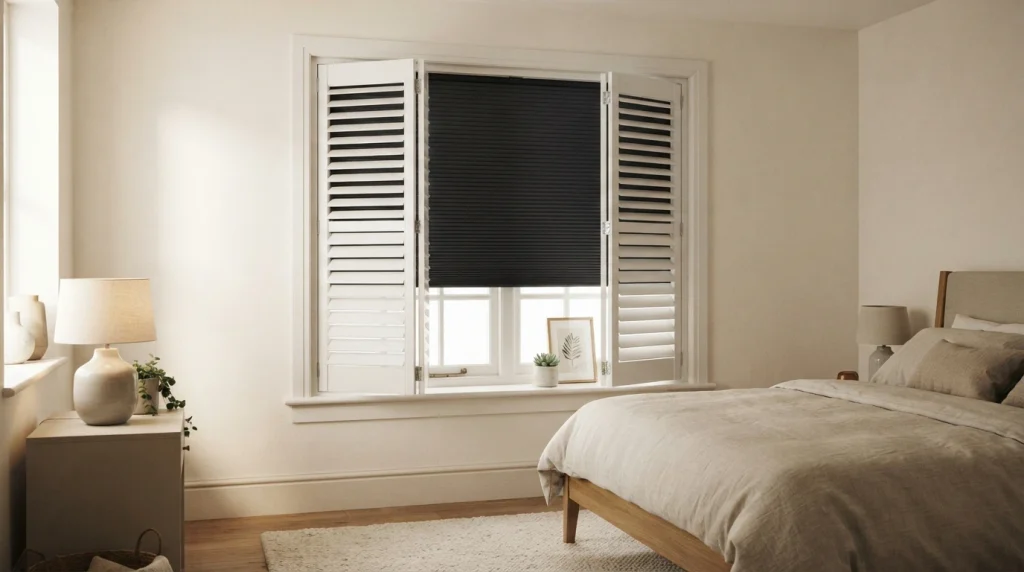
Yes. Some suppliers offer shutters with integrated blinds, with options that include blackout or room darkening fabrics. The blind is fitted behind the shutter panels, usually within a specially designed frame, and can be operated independently of the shutters.
During the day, you can raise the blind and use the shutters to adjust daylight and privacy. At night, or whenever you want a darker room, you can lower the blind to block more light.
This can be a useful option if you like the appearance of shutters but want greater control over darkness, particularly in bedrooms. It combines two different functions in one window covering, without requiring a separate blind to be fitted elsewhere in the window recess.
The level of light reduction depends on the blind, its design and how the whole system fits the window. Terms such as “blackout” and “room darkening” may be used differently by suppliers, so it is worth checking the expected performance and how the system deals with light around the edges.
So, are shutters a good choice if you want a dark room?
Shutters are a good option if you want to reduce daylight, adjust the light throughout the day and maintain privacy. For many homes, that combination is more important than achieving complete darkness.
But if you need a room to be as dark as possible, standard louvred shutters may not be enough on their own. A well designed and installed blackout blind or lined curtain could be a better choice for that specific requirement.
If you want both the appearance of shutters and greater darkness when needed, a combined shutter and integrated blackout blind system is worth considering. The key is to decide how much light reduction you need and then choose a covering that matches that expectation.