
PVC Shutters
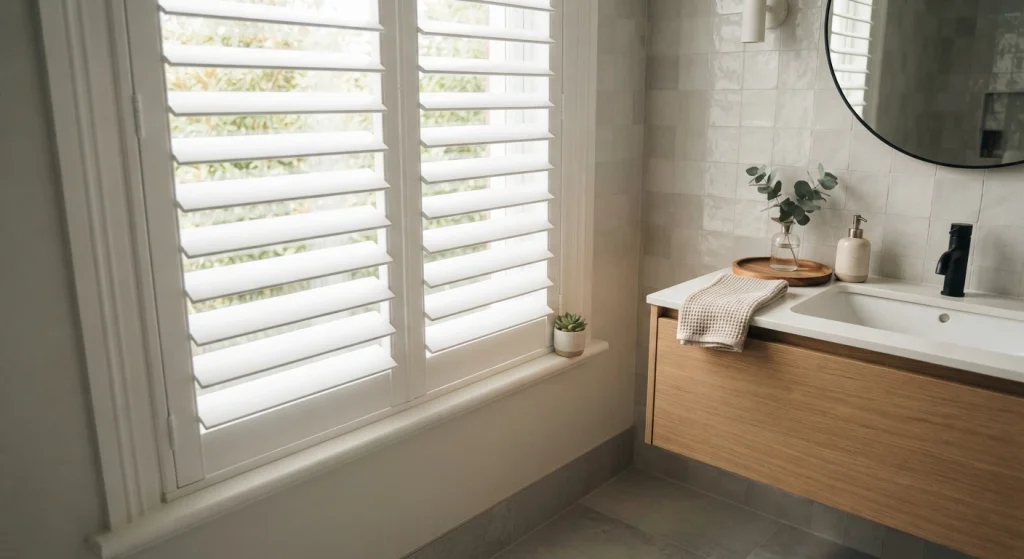
A practical choice for moisture prone rooms
PVC is a synthetic plastic material used in shutter construction, particularly where resistance to moisture is an important consideration. It is commonly used in kitchens and bathrooms and can provide a practical alternative to natural timber in areas where humidity, condensation or occasional splashes are a concern.
✓ PVC pros
- Good resistance to moisture.
- Suitable for bathrooms and kitchens.
- Consistent appearance.
- Generally requires little maintenance.
- Easy to clean.
✕ PVC cons
- Does not have the natural look of real timber.
- Has a more synthetic appearance.
- May have fewer finish options than natural timber.
- Can be heavier than some alternative materials.
- Not as appropriate if you desire a natural wood appearance.
PVC shutters, fully explained…
PVC, or polyvinyl chloride, is a synthetic plastic material used in a range of shutter constructions. It is particularly useful where resistance to moisture is important, which is why this type of shutter is often considered for kitchens, bathrooms and other areas where humidity or occasional splashes may be present.
Resistance to moisture
One of its main characteristics is its low water absorption. Unlike natural timber, it does not absorb moisture in the same way, making it less susceptible to some of the problems that can occur when traditional wood products are exposed to damp conditions. However, the performance of a finished shutter depends on its complete construction, so it is still important to check the manufacturer’s specification rather than assuming every product is completely waterproof.
A consistent appearance
The material generally has a consistent appearance because it does not have the natural grain and variation found in timber. This can work well if you prefer a clean, uniform finish, although it will not provide the same natural character as a stained hardwood shutter.
Different shutter configurations
This type of construction can be used for different shutter configurations, although the available styles, louvre sizes, colours and window shapes will depend on the particular product. Some ranges are designed specifically for areas where moisture resistance is a priority, while others may use the plastic as one component within a wider construction.
Cleaning and maintenance
Another practical consideration is cleaning. The smooth, moisture resistant surface of many products can make them relatively straightforward to wipe clean, which can be useful in kitchens and bathrooms where condensation, cooking residue or everyday splashes are more likely.
Weight and construction
The weight and construction can vary between products. Although the material itself is relatively light, a complete shutter can include additional components or internal structures that affect its overall weight. This is worth considering for larger windows or doors, particularly where the panels will be opened and closed frequently.
Comparing the cost
Cost can also vary considerably depending on the construction, size, finish, configuration and supplier. Some products can provide a more cost effective option than natural timber shutters, although this should be assessed against the specification of the particular range rather than assumed across all products.
Overall, this is a practical material to consider where moisture resistance and easy maintenance are important. It is particularly relevant to kitchens and bathrooms, but the exact level of water resistance, construction and suitability will depend on the individual product. Comparing these details alongside appearance, weight and cost can help determine whether it is the right option for a particular window.